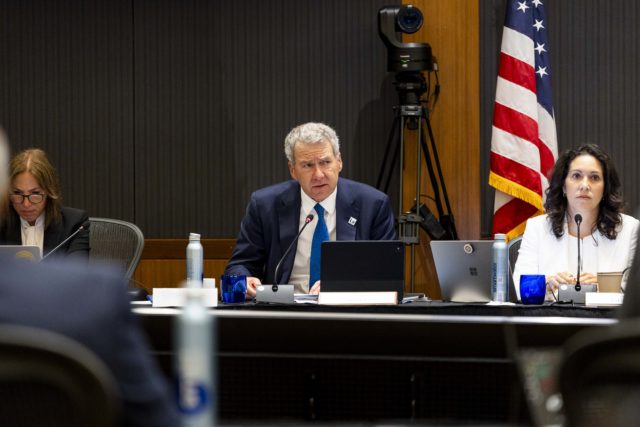
The University’s revenues are increasingly falling short of its operating expenses, the UC Board of Regents said at its meeting Wednesday.
The regents’ Finance and Capital Strategies Committee heard presentations on the UC’s budget and updates on the UCLA West Valley Medical Center and UCLA Research Park projects during its Tuesday and Wednesday meetings at UCLA. The regents must approve the UC’s 2027-28 budget in November before submitting it to the governor’s office for approval.
UC campuses and medical centers have faced significant threats to their revenue streams because of growing expenses, said Nathan Brostrom, the UC’s executive vice president and chief financial officer.
The UC’s operating expenditures are projected to reach roughly $65 billion in 2026-27, with the University relying on a mix of state support, tuition, federal grants, health center revenues and private gifts to fund its operations, according to the agenda item.
“The core fund growth is not enough to sustain both the enrollment growth that we have seen and the academic excellence of our campuses,” Brostrom said.
Fluctuating government funding for the UC has also continued to cause uncertainty, said Caín Díaz, the associate vice president of budget analysis and planning.
The 2026 state budget marked the final year of a five-year compact with the University, an agreement that promises annual funding increases to the UC in exchange for growth in California resident enrollment. The University will also receive nearly $130 million in deferred funding for the 2027-28 fiscal year as signed by Gov. Gavin Newsom in July.
[Related: Gov. Gavin Newsom signs state budget, granting UC $350 million funding increase]
The University’s spending from core funds – which provide permanent funding for UC projects and administrative and support services – totaled around $11.3 billion in 2025-26, or 19% of the UC’s total budget. The funds are pulled from State General Funds, UC General Funds, and systemwide tuition and fees, according to the item.
“Many campuses are grappling with structural deficits, particularly on their core funds,” Brostrom said.
Growth in core funds has been lackluster compared to growth in other University entities such as UC Health, Brostrom said. UC Health represents more than 55% of the University’s revenues – up from 20 years ago, when it represented less than 25%, he added.
The committee also discussed how the UC’s acquisition of the UCLA West Valley Medical Center – located in the western San Fernando Valley – has helped ease overcrowding but has not fully addressed capacity constraints across the health system.
UCLA Health purchased the center, which will provide 260 beds, for $290 million in March 2024, said UCLA Health President Johnese Spisso.
The regents approved the deal in January 2024 to address overcrowding at UCLA Health’s Westwood and Santa Monica locations, according to the item.
“Here in Westwood, we are very congested and operating at 110% capacity,” said Spisso, the UCLA Hospital System’s chief executive officer.
The project’s net income was $396 million in fiscal year 2025, and is expected to be $173 million in fiscal year 2026, she added.
While the project has provided some immediate relief, it has not completely solved the health system’s capacity constraints, Spisso said. With the WVMA project taken into account, the overall health system would have around 1,400 beds, but still would need significantly more to address patient demand, she added.
“We need another 300 to 400 beds just to get out of the boarding crisis that we are in all the time,” Spisso said.
The committee also convened Wednesday to review the UCLA Research Park East Core and Shell Improvements project, which would retrofit a former shopping mall into a multi-tenant scientific research hub. The hub will create a space for research on bioscience, engineering, computer science and artificial intelligence, Chancellor Julio Frenk said.
[Related: UCLA set to acquire former Westside Pavilion mall]
The UC acquired the property – located two miles south of UCLA’s campus – in December 2023 and the regents approved $19.6 million in preliminary funding for the project in May 2025, according to the item.
Pushing similar projects will help counter increased scrutiny from the federal government and makes the UC less reliant on federal funding for basic research, Frenk said.
The federal government froze $584 million in UCLA’s federal research funding in July 2025, alleging that it allowed antisemitism, illegal affirmative action practices and “men to participate in women’s sports.” Frenk denied the allegations in a January interview with the Daily Bruin.
[Related: Federal Funding Cuts to UCLA]
“This is a crucial project,” he said. “The research park will provide us the space we require to translate science into solutions through technological innovation.”
The California Institute for Immunology and Immunotherapy, the UCLA Quantum Innovation Hub and the David Geffen School of Medicine may occupy one of the two buildings, according to the item.
“The way to keep the engine of innovation – which is the funding of basic research – alive and keep America’s leadership in this field is to diversify,” Frenk said. “The most immediate avenue to do so is through technological innovation.”

Comments are closed.