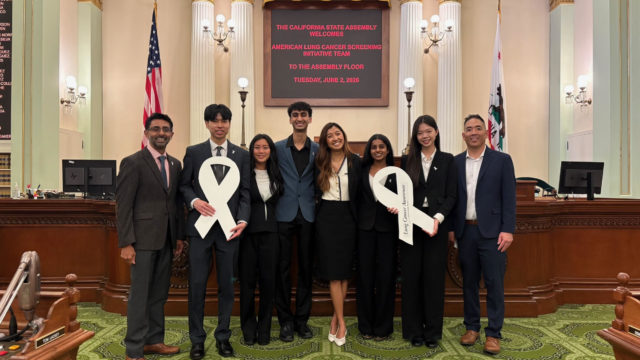
A bill conceptualized by four UCLA students aimed at fighting lung cancer is now awaiting final approval from Gov. Gavin Newsom by Sept 30.
California Senate Bill 1124, introduced by Senator Bob Archuleta in February and passed by the state assembly and senate in August, would require tobacco retailers to display signs raising awareness of lung cancer screening created by the State Department of Public Health by Jan. 1, 2028.
If retailers fail to comply, the state could suspend their business, revoke their license, fine them $500 or charge them with a misdemeanor.
The students, all members of UCLA’s chapter of the American Lung Cancer Screening Initiative, began their legislative effort in March 2025. Elaine Dong, the co-president of the UCLA chapter of ALCSI, said the students contacted state senators and assembly members over 10 months before they found an office willing to sponsor the bill.
“There’s been overwhelming support in every single committee that it’s passed, and so we have strong feelings and strong hope for the governor’s desk,” said Miah Chao, the co-director of ALCSI’s national advocacy team and the co-president of the UCLA chapter of ALCSI.
Health insurance typically covers lung cancer screenings if a patient meets three criteria established by the United States Preventive Services Task Force, said Chao, a rising fourth-year public health student.
Meeting the criteria means being between 50 and 80 years old, having at least a 20-pack-year history – having smoked a volume equivalent to one pack of cigarettes a day for 20 years – and having smoked tobacco within the past 15 years, according to the U.S. Preventive Services Task Force.
“The screening itself is basically going into a machine – we call it almost a donut,” Chao said. “You lay down and you go through the machine. It takes just a couple minutes. It’s non-invasive, pain-free.”
Hiring staff to put the bill into action would cost the state about $426,000, unless they work with an existing campaign like ALSCI, which could lower costs, according to the Assembly Appropriations Committee.
But the estimated financial benefit for the state would be quite high, said Ethan Chen, a national director of ALCSI and former president of the UCLA chapter of ALCSI.
The increase in lung cancer screenings and earlier treatment as a result of this legislation would reduce the healthcare burden of California by at least $26.5 million per year, according to the ALCSI team’s cost benefit analysis.
Gianna Reyno, the director of California operations for ALCSI and former vice president of the UCLA chapter of ALCSI, said the organization’s cost-benefit analysis revealed that 1,917 of the approximately 9,320 annual lung cancer deaths in California could be prevented if patients knew about screenings earlier.
The students inherited the idea for the bill from Alexandra Nees, a UC San Diego medical student who worked with the national ALCSI organization on advocacy efforts, Reyno said.
Chen said they realized through talking to attendees at ALCSI outreach events that many people do not know about lung cancer screening.
The students also received support from many physician advisors part of and outside the ALCSI network, Chen said. Chao credited advocacy efforts from students from UC Irvine, Cal State Fullerton and UC Davis who helped push the bill forward.
“To our knowledge, it (the bill) has a strong chance of passing,” Chao said. “However, we can’t always guarantee what the governor will decide to do. I think one of the biggest concerns that the governor might take into account is the fiscal costs.”
If passed in California, Reyno said, the bill could open doors for the bill to move laterally across other states.
“Our ultimate goal is to see this implemented across the country,” Chen said. “That might be a little ambitious now, but we’re really hoping to see this change spread.”
Beyond the healthcare bill, UCLA’s ALCSI chapter is helping build an educational toolkit for advocacy efforts that they plan to share with the national ALCSI team, said Dong, a rising third-year psychobiology student.
“We actually started an advocacy committee out of our ALCSI chapter at UCLA last year because of the bill,” she said. “Now we’re hoping to of course first to continue supporting the current bill and see if there’s future opportunity to get involved with other bill ideas, and we’re also hoping to explore more into the primary care physician space.”
Chao said the UCLA chapter was also connected by Dr. Drew Moghanaki, one of their UCLA physician advisors, to an LA-based filmmaker who wants to make a film about lung cancer screening with the goal of raising awareness and potentially prompting legislative action.
The club is also looking into using the electronic health record to facilitate conversations about lung cancer screening between physicians and individuals, Dong added.
“Whenever primary care physicians are conducting their annual checkups, they’ll receive an automated reminder to recommend lung cancer screening to different individuals if they meet the eligibility criteria,” Chao said. “We’re hoping to work with different institutions or healthcare systems to see if that’s possible to implement.”
Chao said their small group works well together because they trust each other, allowing them to fight for change.
“It’s really possible to participate in legislative or political advocacy, no matter what kind of discipline you fall under or what your past experiences are,” she said. “You can make so much change, and that’s what we found from just a small group of students here at our university that are able to make – hopefully – impacts on the state level.”



Comments are closed.