UCLA football (3-0, 1-0 Big Ten) will have the opportunity to open conference play undefeated through two games against Maryland (2-1) on Saturday at SECU Stadium. The Bruins triumphed over Purdue 52-38 last week, scoring the most points they had in a game since September 2023. Here is this week’s scouting report from Sports editor Jacob Nguyen, who is ready to see the blue and gold play an entire game in broad daylight for the first time this season, and assistant Sports editor Willa Campion, who is delusively hoping for another 50-plus-point performance.
Maryland’s offense:
Offensive scheme: Pro style
Run-pass percentage: 44% run, 56% pass
Strength: Receiving threats
Weakness: Run consistency
X-factor: Chris Durr Jr.
A week removed from surrendering 425 total passing yards, the Bruins will face a Terrapin offense whose pro-style scheme may enact even more pronounced damage if the blue and gold defense does not improve itself.
Maryland opens its conference slate after posting an average of 11 yards per reception across its first three games, thanks to a deep group of wide receivers that spearhead a heavy dose of air raids and high-tempo attack. The Terrapins boast two receivers with 230-plus receiving yards and two more with 100-plus.
With a 6-foot-5 frame, Kaleb Webb has been quarterback Malik Washington’s early go-to deep-threat X target, flashing a 15.2 yards-per-catch average. Webb has caught 167 yards through three games, using his explosive athleticism to fight through one-on-one coverage along the sideline.
Lining up next to him is Na’eem Abdul-Rahim Gladding, who is second on the team in receiving yards with 239 and receiving touchdowns with two. Gladding’s strong hands allow him to execute plays through traffic and in the air, also excelling after the catch as a decisive route runner.
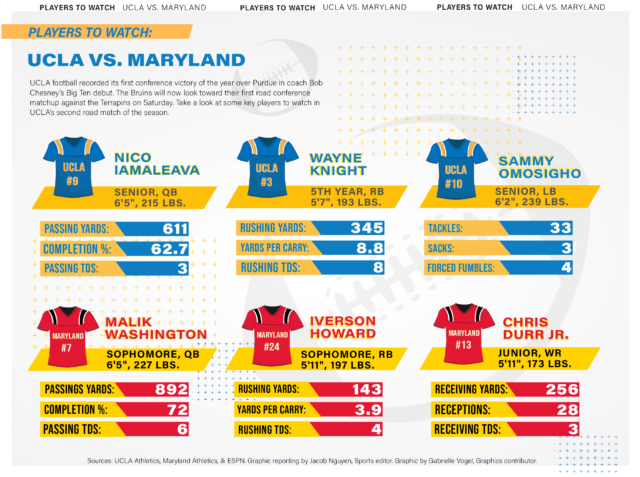
But leading the way is Chris Durr Jr. with a team-high 256 receiving yards and three receiving touchdowns. The Wyoming transfer has shown immense growth as a slot tactician, able to be situated on heavier flanks or in wider spacing.
While Durr is the Terrapins’ standout receiver on paper, Maryland’s depth means that any of the players in its star trio can burst onto the scene for a big night.
Maryland’s versatility in the air bodes well for its offense against a UCLA defense that struggled to line up in man coverage and tackle receivers in open space in its most recent game. Additionally, the Terrapins’ ability to space the field allows them to consistently finish drives, create instant yardage and deploy a diverse playbook.
Of course, this success would not be possible without the return of their hometown kid under center. In his second year starting, Washington is coming off a 359-yard passing performance versus Virginia Tech and has shown high potential as a pocket passer with good processing who can dominate opposing defenses with his arm.
While Washington is not the most potent runner, his proficiency moving out of the pocket while maintaining ball security has helped him open 2026 with six touchdowns and no interceptions.
Although Maryland’s offense has been largely reliant on its pass-catchers in recent years, first-year offensive coordinator Clint Trickett has emphasized a more balanced scheme that uses his running backs as additional spacing options.
Starting running back DeJuan Williams will be out for several weeks following a knee injury suffered during week one. Taking his place has been Iverson Howard, who has shown promise as the new feature back where he can create opportunities in play action. Through three matches, Howard has run for 143 yards and four scores, being particularly impactful behind the line on screen passes.
If the offensive line – which returned a majority of its starters from last year – can continue to hold up to allow Iverson to make plays and give Washington ample time to find options, the Terrapins should be expected to come out of the game swiftly and put points on the board early.
Maryland’s defense:
Defensive scheme: 4-2-5
Strength: Pass rush
Weakness: Downfield coverage
X-factor: DD Holmes
Maryland’s defense was shaping up to have a respectable season until it met its first real opponent: Virginia Tech.
Under second-year defensive coordinator Ted Monachino, the Terrapins took a turn for the worse when they allowed 35 points on Sept. 19 – more than double what they conceded across their first two games.
Despite its lackluster performance against Virginia Tech, Maryland was able to sufficiently pad its defensive stats in its first two games against unformidable opponents in Hampton and UConn. The Terrapins lead the Big Ten in sacks, fueled by the five they recorded in their 62-0 season-opening blowout over the Pirates.
Helming the efforts is linebacker DD Holmes, who, despite having played in only two games thus far, leads the Terrapins with 2.5 sacks, tied for second-most in the conference. Defensive linemen Eyan Thomas and Derrick LeBlanc both also boast two-plus sacks each this season, making Maryland the only non-Michigan team in the Big Ten with three players who have achieved the feat.
Holmes’ absence against Virginia Tech was felt, with Maryland allowing a season-high 314 yards in the air. Despite the Terrapins’ success collapsing the pocket, they struggled to pin down quarterback Ethan Grunkemeyer, and their four-man rush in the second quarter could not stop him from recording his second rushing touchdown of the season off a career-long 18-yard run.
Holmes has been listed as questionable on the availability report for Saturday’s game. Whether he suits up against the Bruins or not could change the game’s tone for senior quarterback Nico Iamaleava, who has been taken down five times so far this season.
Luckily, Iamaleava and UCLA should be able to rely on the run game once again. Fifth-year running back Wayne Knight – who recorded a game-high 177 rushing yards against Purdue – will likely have little resistance breaking through Maryland’s defensive line, especially considering Monachino has yet to fully utilize defensive end Zion Elee. Elee arrived in College Park this year as the highest-rated recruit in program history but has played just 18 of 82 defensive snaps in Maryland’s last game.
Maryland’s nickel defense theoretically loads the secondary, but it is unclear to what effect. Apparent miscommunication left opposing receivers surprisingly wide open during Maryland’s game versus Virginia Tech, and Hokies tight end Luke Reynolds – albeit making impressive catches through coverage – recorded 107 yards off 12 receptions.
To make matters worse, missed tackles allowed the Hokies to make an impact on the run after catch, including on multiple touchdown drives.
At this point in the season, though, UCLA has not found a standout receiver who can exploit Maryland’s weakness in the secondary like Reynolds. Furthermore, if the Terrapins’ pass rush continues to be effective, Iamaleava’s sporadic inaccuracy may be exposed with less time in the pocket, regardless of how open his downfield options are.


Comments are closed.