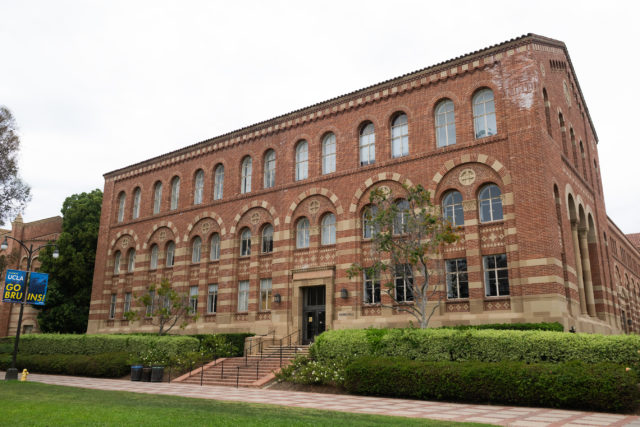
UCLA eliminated dozens of classroom computers this quarter amid budget shortfalls, which faculty said has impacted their teaching.
UCLA Digital & Technology Solutions implemented the Bring Your Own Device policy, which requires instructors to bring their own devices for classes in general assignment classrooms, said Lucy Avetisyan, associate vice chancellor and chief information officer, in an emailed statement. General assignment classrooms – learning spaces overseen by the Registrar’s Office – are located in 22 campus buildings.
The university also plans to install USB-C cords across general assignment classrooms as part of the change, Avetisyan said in the email.
“It’s just a surprise,” said Julie Ko, a Life Sciences Core Education lecturer. “Every time I go to class, I have to figure out what’s new.”
Ko said she previously relied on a classroom computer to project lecture materials while using her personal device to teach. Under the new model, she has to bring two laptops to campus, she added.
Ko said she spent extra class time troubleshooting the projector in Haines Hall.
Emily Castillo, a doctoral student in English and first-time teaching assistant, said she was unable to show her students the presentation she had prepared for their first day because of the policy change. Her classroom did not have the equipment to connect her personal computer to the classroom projector, she added.
The new model comes as the university works to “align with fiscal realities,” Avetisyan said in the email.
UCLA had a year-end budget deficit of $58 million for the 2025-26 fiscal year, below the university’s $220 million projection in March, Chancellor Julio Frenk said in a Sept. 24 campuswide email. The new figure only applies to UCLA’s central account – including state funding, tuition and facilities costs – instead of the combined deficit across campus, Frenk said.
Stephen Agostini, UCLA’s former chief financial officer, alleged in February that UCLA had a projected $425 million budget deficit and had posted erroneous financial reports. Agostini was out as the university’s CFO four days after the Bruin published his claims.
[Related: Frenk says UCLA’s year-end budget deficit is significantly smaller than expected]
Faculty and TAs who do not have their own devices can loan computers through the UCLA Library Campus Library Instructional Computing Commons, Avetisyan said in the statement. She added that DTS keeps emergency devices if instructors need it for a single class session.
About 20% of UCLA’s classroom computers were used last year, Avetisyan said in the statement. The classroom computers were prone to cybersecurity risks that DTS and UCLA Facilities Management actively monitored, she added.
“I increasingly feel that the nuts and bolt support for teaching—in class computer support, good wi fi, the ability to show films on Bruinlearn—is sorely lacking, and it’s an embarrassment and a disappointment,” said Helen Deutsch, a professor of English, in an emailed statement.
Deutsch said she faced difficulties setting up her slides during lecture and had a student help her navigate the new system. The classroom computer could have saved her time, she added in the email.
“I know that UCLA invested a lot of money in those machines and I think it’s unfair and pointless to spring this on us at the last minute,” Deutsch said in the statement.
The University Council-American Federation of Teachers, a union representing more than 7,000 UC faculty members and librarians, criticized the new model in a Sept. 25 Instagram post. The union said UCLA did not notify it about the policy change, adding that the removal of classroom computers violates its contract with the UC.
The policy follows UCLA’s decision to lay off and eliminate the positions of 27 DTS employees in late June. The union demanded in the Instagram post that UCLA restore all classroom computers and rehire information technology support staff who were let go.
[Related: UCLA cuts 27 DTS jobs amid budget deficit, UPTE-CWA 9119 alleges contract violation]
Tim Groeling, the chair of the Academic Senate, said in an emailed statement that the senate did not play a role in the new policy.
“I appreciate the efforts DTS has been making to address faculty concerns,” Groeling said in the email. “But overall, I think this rollout would have proceeded with much less disruption and much more confidence and support if it had been done with adequate Senate consultation and earlier communication with instructors.”
The policy has created additional technical problems for faculty and Audio Visual Services instead of addressing them, Ko said.
“I understand the rationale is for financial reasons,” she said. “But the number of tech issues that are still cropping up is not helping.”
Contributing reports by Nicholas Mouchawar, Campus politics editor.


Comments are closed.