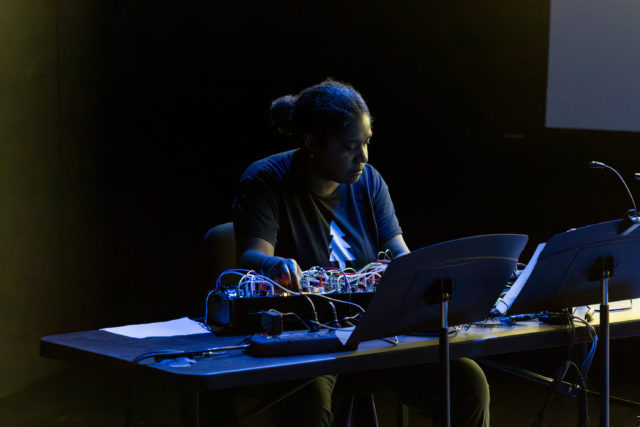
The UCLA Nimoy Theater harvested a new soundscape in Westwood.
With an almost full house, the 299-seat venue, described as a “reimagining of the historic Crest Theatre,” hosted award-winning composer Yvette Janine Jackson with her Radio Opera Workshop on Friday. Around 8 p.m., attendees at the UCLA Nimoy Theater entered the auditorium for an evening of radio opera – a term used by Jackson to describe her narrative composition, in which she uses a variety of auditory elements, weaving in historical and social context. Jackson premiered her latest piece, “Harvest,” followed by a conversation moderated by assistant professor Tiffany E. Barber that explored Jackson’s creative process.
“Radio operas are a piece inside of a piece inside of a piece, or a process inside of a process inside of a process,” Jackson said. “I think about the relationships between humans and these electronic instruments.”
Jackson is a Los Angeles native known for her electroacoustic, chamber and orchestral music, which she has performed internationally at notable venues, such as the iconic Carnegie Hall in New York. Additionally, she has crafted multiple sound installations, including “Destination Freedom,” a permanent exhibition at the International African American Museum, also highlighted by the artist in her personally curated playlist.
[Related: SCA hosts Royce Welcome Concert to kick off school year, features student musicians]
Jackson said she refers to her work as “radio operas” because, like her compositions, radio dramas create storylines with just audio in a darkened theater, curating images with the help of listeners’ imagination. While “Harvest” does include visual elements, the artist added that the same essence remains.
While the evening primarily focused on the official premiere of Jackson’s latest work, attendees interested in getting a more in-depth look at the artist were welcomed into the theater an hour before the official workshop for a reception open to all ticket-holders. The reception included a few installations, such as archives with information about Jackson’s inspirations and a curated playlist by the composer featuring a few of her pieces.
At exactly 8:15 p.m., Jackson took the stage with three musicians – Mattie Barbier on trombone, Dawn Norfleet on vocals and flute and Jessica Shand also on flute. As the lights dimmed, the show began with noises of farm life, featuring animals such as sheep, cows and birds. This cryptic atmosphere created by these sounds was intensified by the no-filming policy, allowing audience members to fully immerse themselves in the unfamiliar piece.
As the performance developed, Jackson complemented the musical instruments with her semi-modular synthesizer and other equipment, adding vibrations and static-like sounds. Afterward, there were multiple spoken words referred to as audio texts of news headlines, touching on themes such as agriculture and its work conditions, with an emphasis on the innovation of seedless fruit – a nod toward the evolution of food gatherings shifting along with technological advancements.
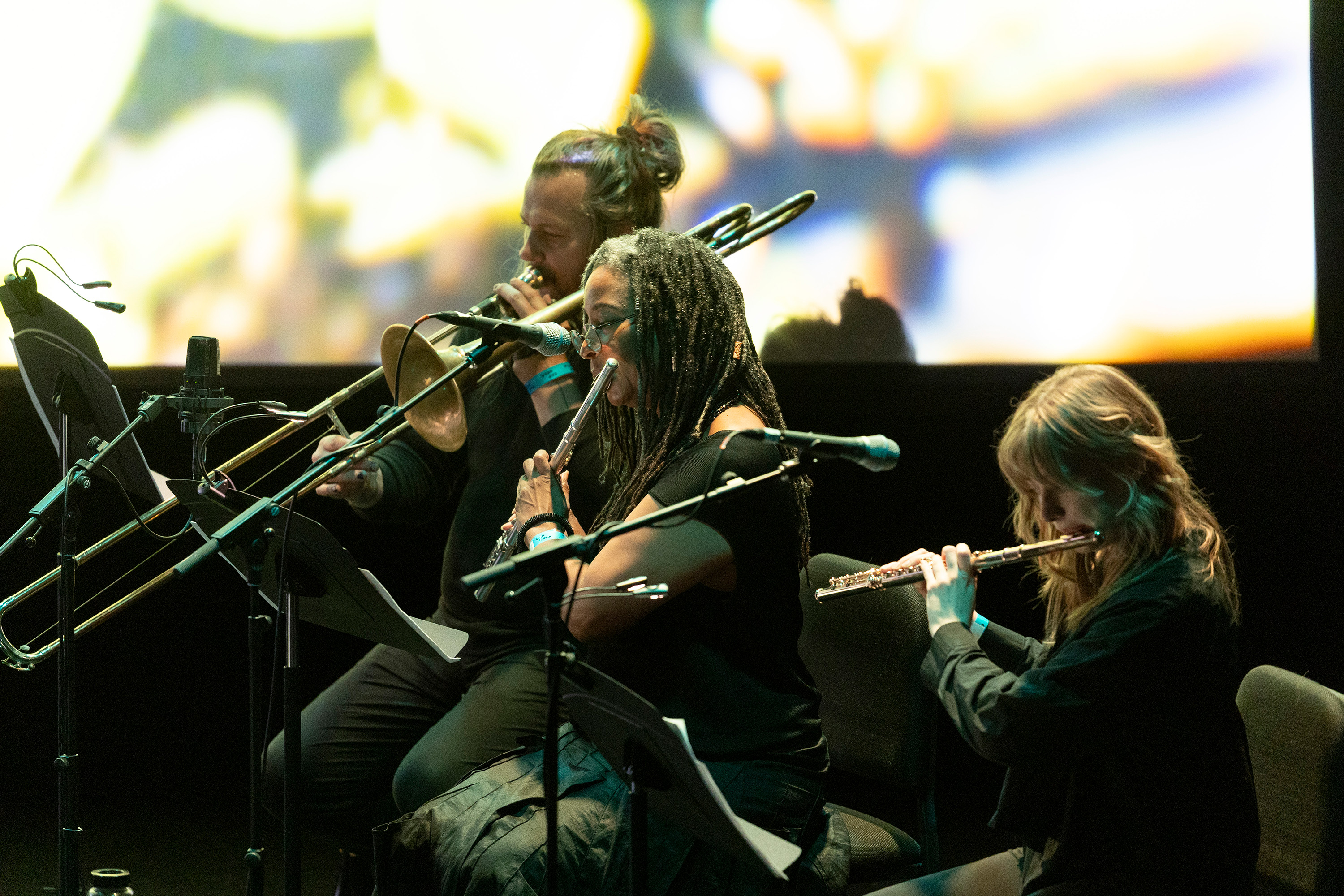
The incorporation of seeds in the audio element was inspired by Jackson’s recent interest in homestead lifestyle content, she said. When consuming this content, Jackson added that she noticed people struggling to grow their crops, and later learned that the majority of seeds in the world are monopolized by four companies.
The piece eventually started incorporating more technology- and science-based imagery – such as petri dishes and space rockets – through video and audio texts. One of the evening’s most striking juxtapositions came from the transition from those agrarian themes to solar panels placed in rows reminiscent of crop fields.
Throughout the performance, “Harvest” explored different forms of technological advances such as the use of machinery in agriculture. The piece contrasted these themes with simpler, natural processes such as growing and sharing food, and it explored how those have shifted with scientific developments, such as the main imagery of seedless fruit.
Hana Chizzo, a third-year music industry student, said Jackson’s work is something completely new for her, even as someone who both creates and enjoys electronic pieces. The combination of live instruments with Jackson’s synths creates a form of storytelling distinct to the “Harvest” composer, she added.
“This is such a cool way to storytell in a way that I haven’t seen before, in a way that I haven’t even attempted before,” she said. “I’m definitely taking that for inspiration for projects that I’m gonna do, and also a new way to tell stories about life and dreams.”
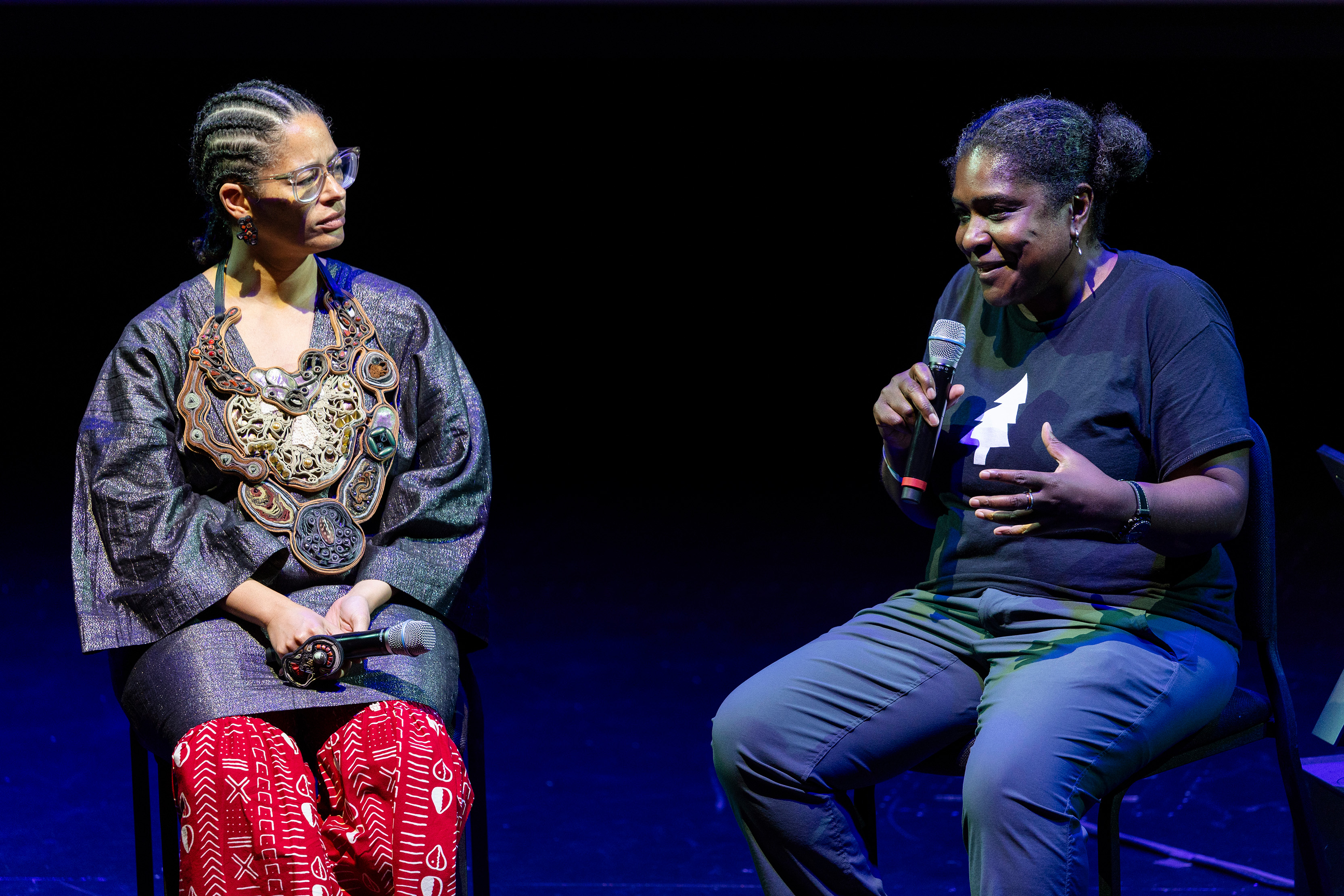
The role of the live instruments became almost soundtrack-like over the course of the night. Jackson’s directions were depicted by the combination of filmmaker Ava Porter’s work and the musicians’ multiple instrumental techniques, such as Norfleet using her vocals while creating airy sounds with her flute.
While the story told by “Harvest” is nonlinear sonically, Jackson said the process creating it fell into a step-by-step system. Starting by discussing the themes with collaborators, this conversation eventually translated into a five-act storyboard, she said. Porter said it was through back-and-forth conversation that she and Jackson landed on a “space western” theme. The images are more straightforward than the sound, Porter said.
“This is sort of an exploration of the innovations that we live with, in science and industry, in food, in control, in space travel – a contradiction between what’s happening on the planet,” Porter said. “The images, I think, structure things a little bit more linearly than the audio does … but really, that was all following the concepts that Yvette had expressed to me.”
[Related: Tom Cruise takes over Westwood for “Digger” premiere mere steps from UCLA]
The post-show discussion ran for over 20 minutes, during which Barber asked the composer about the dynamics of weaving sound and images. While Jackson shared many details about her creative process, she said she prefers to not overexplain the project to maintain its enigma. She added that she hopes each audience member can build their own interpretation based on their individual life experiences.
“A room like this, everyone has heard something different, even though we were all in the same room experiencing the same thing,” Jackson said. “I like to leave room for the audience as a part of the radio opera. The radio opera wouldn’t exist without the audience.”

Comments are closed.