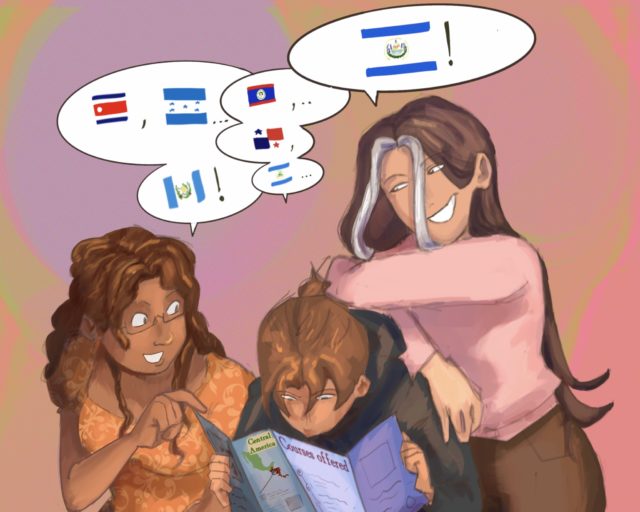
My family is from the smallest country in Central America, El Salvador. It is often referred to as “el pulgarcito,” or the little thumb.
My mom prioritized teaching and maintaining my Spanish so I could connect with my Salvadoran family. Still, I longed to connect with my culture beyond language.
So, I took a Chicano studies class. I learned about Salvadorans in the United States across the ’80s and ’90s, and how the United States denied asylum for 97% of Salvadorans in the 1980s. I learned about the Nicaraguan Adjustment and Central American Relief Act.
The class was an incredible eye-opener to Central American history and immigration legislation – topics of which many students have little understanding.
It also taught me that UCLA must continue to grow its Central American course catalog, and more students should take advantage of the rich history taught through the Chicana/o and Central American Studies department.
Helen Burgos-Ellis, a continuing lecturer in the department of Chicana/o and Central American Studies, said there were not many Latin American courses available when she was an undergraduate at UCLA in 1998. That changed when she returned to pursue her master’s in 2006, she said.
“It feels luxurious to be able to engage in studying your people, making sense of it and explaining it to ourselves, but also to those who are interested in understanding our connections in the human experience,” Burgos-Ellis said.
Central American studies courses are for more than learning about culture. They are an opportunity for in-depth interpretation of history and its application to the current day.
“Nobody needed to teach me about my cultural foods because my tía was already doing that,” said Floridalma Boj Lopez, an assistant professor in the department of Chicana/o and Central American Studies. “But what I didn’t necessarily understand is, for instance, when did Guatemala even become a country, and who led that process of becoming a country and why did we have to migrate?”
Curiosity about our cultural backgrounds is an important desire the university should help students fulfill.
Central American studies courses are also transferable to other contexts around the world, Boj Lopez added.
The university should also consider expanding Central American classes as part of its pursuit to be recognized as a Hispanic Serving Institution, which requires a 25% Hispanic or Latino undergraduate student body.
Latino first-year students increased by 4% and comprised 26% of the 2024-25 class, while Latino transfer students comprised 28% with a 6% increase. It’s key, though, that those students are more than a number – and have classes they identify with when they get to campus.
Central American courses, though, should be encouraged for all students – not just those from Latino backgrounds.
“You have everything to gain by having deeper understanding, more language, more history and a connection to a really diverse body of people,” said Kaelyn Rodriguez, a Santa Monica College professor. “There’s really nothing to lose, only anything to gain – everything to gain.”
UCLA must grow the department for the benefit of students and staff. UCLA, don’t overlook Central American studies – not even the little thumb.

Comments are closed.