This post was updated Oct. 20 at 10:50 p.m.
More than a year after the city of Los Angeles placed restrictions on where people can sleep or camp in public spaces across Westwood, controversy over the limitations’ effectiveness in addressing homeless encampments remains.
These anticamping zones – established under LA Municipal Code Section 41.18 – allow the city to issue citations to people who sit, lie down or store personal property in areas that block the public right-of-way and near schools and daycares, such as Geffen Academy and the UCLA Westwood Child Care Center. The LA City Council can vote to add additional 41.18 zones, which has led to additional anticamping areas around Westwood Park and the Westwood Branch Library.
Of the 1,856 people the city contacted in 41.18 zones between 2021 and 2023, only two received permanent housing and 313 entered interim housing, according to a 2024 report by the LA Homeless Services Authority and the city of LA’s chief legislative analyst.
“It doesn’t house people. It doesn’t help people. It is cruel and unusual,” said Jacob Wasserman, a former North Westwood Neighborhood Council board member. “It doesn’t even do what it set out to do.”
Wasserman said he asked the city to update and remove several zones on an online public map because they were inaccurate. These inaccuracies – including zones around an online school on Hilgard Avenue, a closed daycare on Charles E. Young Drive and an expired temporary ban near 99 Ranch Market – could result in confusion and false citations, he added.
The zones prevent camping within a 500-foot radius of protected sites without accounting for street grid layouts or whether restricted spaces such as alleyways lie along walking routes to those sites, Wasserman said.
LA City Councilmember Katy Yaroslavsky, whose district includes UCLA, introduced a resolution in 2025 to ban camping in Westwood Park and Westwood Branch Library despite pushback from the NWWNC.
Yaroslavsky did not respond in time to a request for comment about the effectiveness of the zones and the recent updates to the online map.
[Related: LA City Council adopts anticamping resolution despite NWWNC pushback]
LA City Council voted in August to remove 12 anticamping zones in other areas in LA, including parts of Echo Park and Silver Lake. The council also voted in October to delay a motion to expand the 41.18 ordinance to other spaces, such as fire and police stations.
Andrew Lewis, chair of the NWWNC’s Community Health, Homelessness, and Safety Committee, said his committee opposes 41.18 because they believe it is a Band-Aid solution. City staff housed and offered services to a cleared encampment on the corner of Westwood and Santa Monica Boulevards, he added.
“Our council’s perspective has been that it’s … not a solution-based tool,” Lewis said. “It just moves people experiencing homelessness around to different areas.”
Advocates for 41.18 zones argue that the zones address sidewalk accessibility concerns and protect students’ safety when encampments block the right-of-way or cluster around schools, Lewis said.
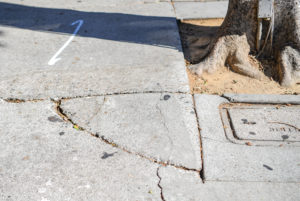
However, Wasserman said the city can better address safety concerns by repairing broken sidewalks, shortening wait times around transit stops and improving visibility with street lights.
“There are people who harass women on the street, who block sidewalks, do drugs in public, you name it, destroy property, but all of those things are illegal,” Wasserman said. “41.18 doesn’t make any of those things illegal.”
The number of people who reported experiencing a sweep – 41.18 and otherwise – decreased slightly from 2023 to 2026, according to a study led by Randall Kuhn, a researcher and professor at the Fielding School of Public Health. However, the percentage of those who reported they had been offered housing after a sweep decreased from 17% to 9%.
Within a month of experiencing a sweep, respondents were more likely to report symptoms of depression and anxiety, loneliness, poor sleep and emergency room visits, Kuhn said.
By making encampments less visible, it is less likely that residents can call for help if a person experiencing homelessness faces health or safety issues, Wasserman said. Encampment sweeps can disrupt outreach efforts to offer medicine to people experiencing homelessness, Kuhn added.
Kuhn, a member of UCLA’s Unhoused Task Force, said the group recommends the city develop non-police responses for disturbance calls, conduct outreach to encampments and educate students, faculty and staff on how to help.
“41.18 is never really an acceptable approach,” he said. “The harms are so obvious, and the benefit is so counterproductive that I wouldn’t even consider that to be a viable option in any zone.”



Comments are closed.