This post was updated Oct. 22 at 11:19 p.m.
Using light rays to turn off and on certain regions of mice’s brains is a normal part of Avishek Adhikari’s day in his lab.
Adhikari learned the technique – termed optogenetics – as a post-doctoral researcher under Dr. Karl Deisseroth, a Stanford University professor of bioengineering and psychiatry and recipient of the 2026 Nobel Prize in Physiology or Medicine for co-developing the method.
Now an associate professor of psychology at UCLA, Adhikari uses this Nobel Prize-winning technique to pioneer studies regarding fear and food in mice.
“This method of using optogenetics to dissect the function of neural circuits is the bread and butter of what we’re doing here in our lab,” he said.
Adhikari said he was not surprised to see Deisseroth win the Nobel Prize because his discoveries impacted neuroscience, psychiatry and neurology fields worldwide. Adhikari added that Deisseroth’s techniques allowed him to make new discoveries on how different parts of the brain influence eating and fear behaviors in his lab.
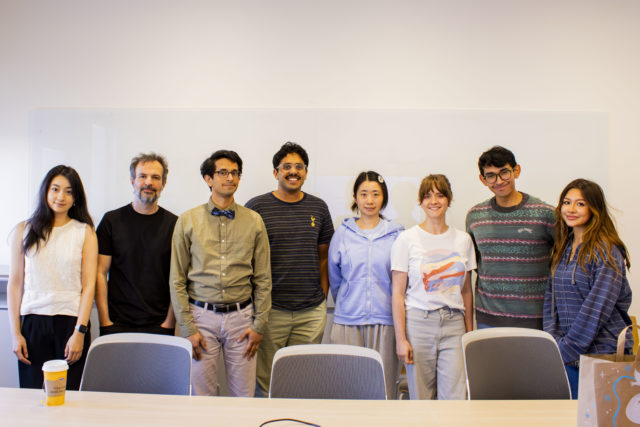
“This lab is what they call basic research, and it’s the first step on the ladder to research that can apply directly to humans,” said Enya Walker, a member of Adhikari’s lab and third-year doctoral student in psychology. “The better that we can map out the brain, the better we can understand how it works and how we can use it to better treat.”
The area of the brain she’s studying – the zona incerta, or “uncertain zone” in English – using optogenetics is targeted by a treatment for Parkinson’s in humans, Walker said.
How that treatment works, however, is not fully understood, Walker said. She added that she hopes to explore the exact mechanism and understand its effect on fear and feeding behaviors to work to improve the therapy.
Blake Alec Miranda, a lab member and fifth-year doctoral student, said they used UCLA’s miniscope – which provides precise brain imaging for small animals like mice – in Adhikari’s lab to study how certain brain cells in mice contribute to recognizing fear in other animals.
Miranda said his work revealed that cells in the prefrontal cortex, an area typically associated with social behaviors, also caused mice to recognize when other mice freeze from fear and then freeze itself – a discovery that no one had seen before.
“We all sort of understand the feeling of knowing that others are afraid,” they said. “Research like this is just making concrete what we already know to be true.”
Adhikari added that this discovery was important because labs typically study the effects of fear on singular animals, but, in real life, threats happen most often in group settings.
Anita Liu, a second-year doctoral student in psychology, behavior and neuroscience, said she wanted to join Adhikari’s lab since she was an undergraduate at UCLA after learning he used optogenetics.
Now as a graduate researcher in his lab, Liu said she uses this technique to investigate how certain neurons influence how mice value food.
“The way I always describe it is, the value of food in our lives as humans is constantly changing,” said Nitish Patel, a lab member and fourth-year doctoral student in psychology. “After a big dinner, savory things are usually less valuable, but a sweet treat like ice cream or dessert can then be more valuable at that time – even though technically you’re full.”
Manipulating these cells through optogenetics can change which foods mice choose to eat, Patel said, and activating them causes mice to choose fatty foods such as cheese and chocolate instead of broccoli or carrots.
Semaglutides – GLP-1 receptor agonists similar to Ozempic – decrease activation of these cells, which suggests they could be targets for future weight loss therapies, Liu added.
“Since this population is sensitive to semaglutides, or GLP-1 agonists, it could also suggest other drug interventions and seeing what the exact mechanisms of GLP-1 agonists are, which is still not currently understood in the brain,” she said.
Adhikari said Deisseroth made efforts to get to know each member of his 50-person lab while working as a psychiatrist, which influenced him to be more hands-on in his own methods and when he approached research problems.
“A lot of the questions being investigated in the lab had this underlying motivation of empathy for the problems that his patients were having,” he said. “And how we could make some discovery that could eventually guide some therapy to help those people that he was seeing as patients.”
Because Adhikari visits the lab every day to help students, projects progress much faster than in traditional lab environments where they typically only hold weekly meetings, Patel said. Adhikari often attends lectures with her to learn more about a topic he’s interested in, even participating in class discussions, Liu added.
“You see all these principal investigators in the field, and you think they know everything. But Avi, he’s very open about things he doesn’t know,” Patel said. “He’s been a good example that I can ask questions at any point.”



Comments are closed.