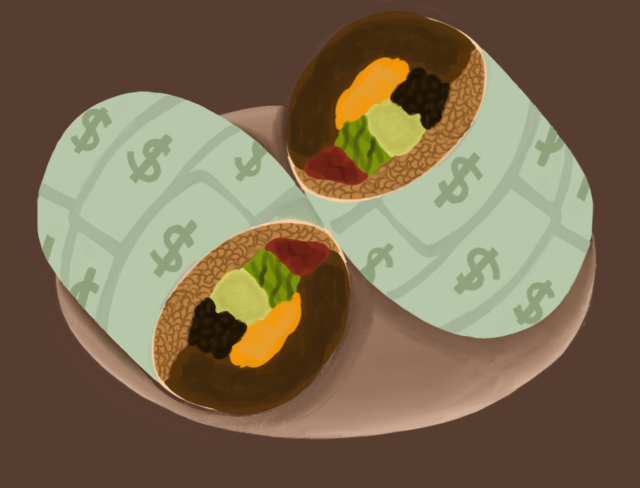
There’s a lot of guilt associated with spending money on food as a college student, and the great $20 burrito debate of 2026 on X should show us why that’s misguided.
Turning Point USA spokesperson Andrew Kolvet posted Aug. 4 on X about a college student’s complaint that burritos cost $20.
“A lot of this is a hangover from Covid and Biden-era inflation, but the lived experience is the same: It just feels like basic things cost too much,” Kolvet said.
Kolvet’s post sparked controversy, as many disagreed and blamed students for being lazy.
Fox News contributor Marc Theissen followed, writing, “Cry me a river. The burritos in the college cafeteria are included in your meal plan.” Similarly, Fox News host Tomi Lahren dismissed those who “all also get a daily iced coffee.”
People more willing to consider the full picture, though, acknowledge the impacts of inflation, blame Trump and agree that groceries have gotten exceedingly expensive.
Convenience doesn’t look like cheap instant ramen anymore. In 2026, college students care about choosing nutritious – or at least tasty – foods. Food insecurity is a result of the cost-of-living crisis, inflation and low wages – problems that UCLA and California policymakers should try to solve.
Students aren’t lazy. This issue is a side effect of a tiered social, economic and political struggle. Criticism about buying expensive food is baseless – and students already feel guilty enough about it.
“It’s honestly really hard to find $1 ramen,” said Alondra Sanchez, a first-year business economics student.
The good ol’ $5 Subway footlong is gone. Today, a footlong costs up to $15.86. High prices are the norm, and some students may feel like they have to choose between their academic success and food affordability. Between studying and classes, it can be challenging to find time to cook meals.
Convenience has a price – and if you want to consider the quality of food, that price only increases.
Smoothies offered at Kreation Kafe in Westwood range from $12.90 to $20.85. Kreation prides itself on its nutritious foods that “nourish and delight.”
For some students, the cost is worth it.
“I typically will spend $17 on a Sweetgreen salad,” said Camila Martinez Penaranda, a third-year public health student. “I do think it’s worth it.”
Social media has brainwashed us to feel guilty about every diet choice we make. It’s seen as unhealthy to buy nonorganic foods. Students can justify Erewhon’s high price points because of nutritional fearmongering and health trends. Even instant ramen is dismissed as an empty carb with too much sodium, so opting for a pricier salad feels more reasonable.
The issue is especially relevant to college students, who expend a lot of brain power on school, studying and other extracurriculars, Martinez Penaranda said.
“Nutrition is one of the things I care about the most,” Martinez Penaranda said. “I think that’s one of the best health investments in the long run.”
With that said, there are resources at UCLA such as Bruin Dine, which recovers food from dining halls and redistributes it for free three times a week at the Student Activities Center.
Food assistance helps students have more autonomy and freedom, but the bigger problem is spreading information and awareness about these programs, said Gabrielle Chang, co-internal vice president of Bruin Dine.
Governor Gavin Newsom also expanded CalFresh in October 2026 to allow students enrolled at any University of California school to be eligible for about $300 a month for groceries. But policymakers should do more to help ease the financial burden on students.
This is a step in the right direction, but awareness of the eligibility of CalFresh and campus resources like Bruin Dine must be expanded upon. UCLA also has room for improvement and should join efforts to better publicize food assistance resources.
College students shouldn’t bear the blame for our poor economy, social standards and political failings. Students aren’t unwilling to cook. It’s that basic choices, even at the grocery store, feel overwhelming and too pricey.
If a $20 burrito makes your workload a little lighter and provides convenience, don’t feel guilty about buying one.




Comments are closed.