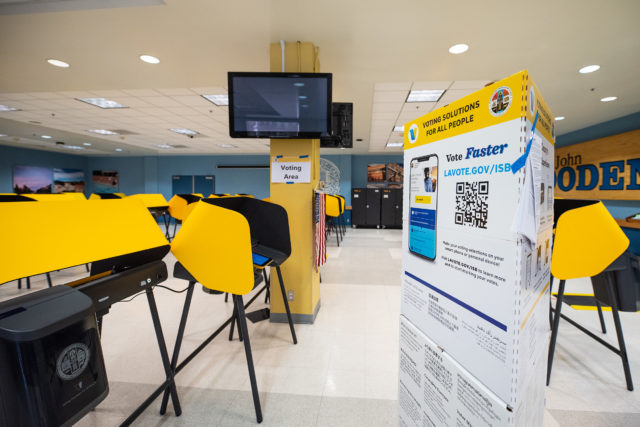
Proposition 39 could invalidate thousands of ballots. Vote “no” this midterm election to protect yours.
The proposition intends to address fears of voter fraud by adding voter identification laws for in-person and mail-in voting.
These efforts might be valiant if voter fraud was a legitimate concern. Instead, the laws add extra barriers to casting a ballot that disproportionately harm underrepresented voting groups and strategically benefit the Republican Party.
Voting “no” will uphold free and fair elections in California.
Current requirements verify a voter’s identity with just their signature. If passed, Proposition 39 would require every California voter to provide the last four digits of a government-issued ID for mail-in ballots and show a valid ID at the polls for in-person voters. While the proposed rules might seem mundane, there’s more beneath the surface.
Possession of government-issued IDs, like birth certificates and social security cards, is highly unequal along racial lines, said Emily Woo, a third-year political science doctoral student. When there are stricter voter ID laws, participation in elections tends to drop, with a disproportionate impact on people of color, she added.
Proposition 39 is born from fears that voter fraud is a rampant issue, which President Donald Trump has perpetuated. These claims, though, are often baseless.
“There’s no evidence that election outcomes are ever affected by fraud,” said Joseph Fishkin, a professor of law.
Forward-thinking UCLA students are opposing the change, too. Adding voter ID laws could also amplify allegations of voter fraud, said Chelsea Brodie, a first-year neuroscience student. It could validate unsubstantiated claims of rigged or stolen elections, she added.
Proposition 39’s strategic advantages to the Republican Party don’t stop there.
Voter ID laws tend to disadvantage Democrats. Although California is a staunchly blue state, Proposition 39 could still increase its share of Republican votes. A study from The University of Chicago Press Journals found that Democratic turnout dropped by an estimated 8.8 percentage points in primary elections when strict voter ID laws were introduced, compared to dropping just 3.6 predicted percentage points for Republicans.
This could allow Trump and the Republican Party to capitalize on blue voters being blocked from the polls.
Still, advocates for the proposition may still argue that extra security in California’s elections wouldn’t hurt. After all, it asks for just a few numbers on an ID.
And to some extent, Proposition 39 does respond to voters’ concerns that fraud is jeopardizing the legitimacy of California’s elections, Fishkin said. But the number of voters whose ballots may be rejected because of Proposition 39 is a greater concern, he added.
One study estimated that in two Wisconsin counties, voter ID laws deterred between 8,000 and 17,000 nonvoters after they were implemented prior to the 2016 election. The study estimated these extra restrictions disproportionately deterred voters who have less formal education, voters who earn lower incomes and Black voters.
Such laws do not only discriminate against underrepresented racial groups. College students could also have a harder time voting.
Proposition 39 could make voting more difficult for college students and young people who move frequently, aren’t from California or don’t have a driver’s license to vote, Fishkin said.
“Students are right in the heart of the population that often is going to be disenfranchised by any new restriction put on elections,” he said.
Proposition 39 risks California losing more credible votes than catching illegitimate ones. Voters already face challenges when casting their ballot, such as the time it takes to research candidates and propositions or even making it to the polls.
Students should vote “no” on Proposition 39 to avoid making elections even more difficult to participate in.
The government wouldn’t try so hard to take your vote away if it didn’t matter.


Comments are closed.