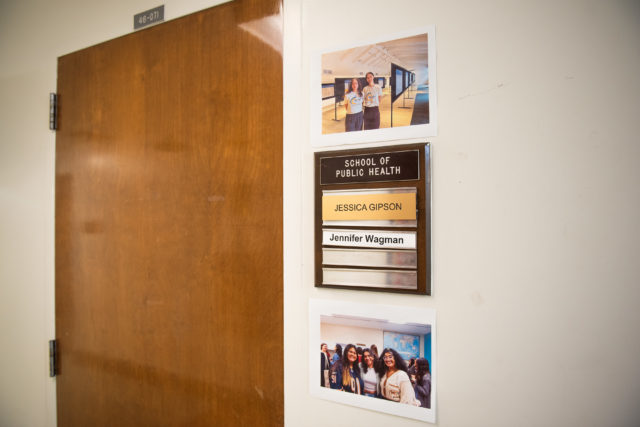
While Jennifer Wagman taught a women’s health class at UC San Diego, seven students confided in her and disclosed their experiences with sexual violence.
Wagman, now an associate professor of community health sciences at UCLA, helps students with similar experiences through her research at the Wagman Lab, which studies domestic and sexual violence to understand its impact and inform preventative measures.
“When I came to UCLA, I was really excited,” she said. “I’ve had the opportunity to teach classes and work with folks to better understand why it’s important to look at violence as a public health issue.”
Her research team found that students distrust some university systems, Wagman said. Students said they felt lost on how to report their abuse and lacked support during the process, she added.
Taylor Thomas, the program coordinator at the Wagman Lab, said the lab’s internal research interviews with victims often provide unexpected support. It’s sometimes the first time students reported having experienced sexual violence to a source other than close friends and family, Wagman added.
“Students are willing to and sometimes even relieved to talk to someone on a research team,” Thomas said. “We’re an impartial person, … and everything is confidential.”
Researchers combine qualitative information with quantitative data to understand root causes of violence, Wagman said. From there, the team creates informed recommendations for how university offices – such as UCLA Counseling and Psychological Services and the Title IX Office – can better handle reporting and victim safety, she added.
“Higher education, it’s just a behemoth of an institution,” Wagman said. “It’s very static. It’s very resistant to change.”
In 2022, the lab published a state-funded study that showed the barriers survivors face in gaining restraining orders from their attackers. It also created a domestic violence restraining order task force composed of city officials, which works to change policies being used in family justice centers and the court systems, she added.
The Wagman Lab often partners with other universities, such as UC Irvine, in its projects, Wagman said.
Ariana Schieferle, a volunteer researcher at the Wagman Lab, said student researchers often inspire projects at the lab based on their own experiences and observations on campus.
“To me, it’s essential if doing any of this work that students are really leading it,” Wagman said. “You all know what needs to be done and what’s going on.”
Emeline Lee, an undergraduate researcher in the lab, said the team’s professional diversity also allows the lab to incorporate a range of perspectives into their work.
“It’s really interesting to see what everybody brings to the table with their different projects,” said Lee, a third-year molecular, cell and developmental biology student.
Beyond campus, the Wagman Lab researches external issues – such as the Los Angeles court system, how pets can affect unsafe relationships, and suicide and sexual violence interventions.
In the future, the lab hopes to conduct more campus-based research. A former Cornell student’s recent lawsuit – which alleged that seven of her peers raped her at a fraternity house and gained national attention – has further galvanized the lab into action, Wagman said.
“Higher education is in a very strange place right now,” she said. “I’m hopeful that this will be an opening for some transformative change.”





Comments are closed.